Loop Engineering Replaces Prompt Engineering as AI Agents Learn to Work Without Human Input
When ChatGPT debuted in 2022, the way people interacted with AI revolved around one simple idea: users write a prompt, share enough context, and the AI model generates a response. Prompt engineering quickly emerged as a coveted skill. The better the prompt, the better the output.
For a time, prompting was the interface. Then came AI agents, capable of carrying out tasks autonomously with minimal human guidance. Users could assign tasks, review the agent's work, and step in when needed.
Now, that workflow is also evolving. Developers are setting up recurring systems with a defined purpose that AI agents iterate until complete. This is known as loop engineering. It eliminates the need for a user to type a prompt using their fingers in order for the AI agent to work on their behalf.
What Industry Leaders Are Saying
Several AI experts have urged developers to embrace loop engineering. Boris Cherny, head of Anthropic's Claude Code, told CNBC that he no longer writes AI prompts:
"It's an agent that prompts Claude. I don't write the prompt anymore. Claude writes the prompt, and now I'm talking to that new Claude that is kind of coordinating."
Cherny further stated that loops represent the kind of work he would be proudest of in a decade.
Peter Steinberger, an OpenAI engineer and creator of the viral OpenClaw project, issued a blunt reminder to users still writing prompts:
"Here's your monthly reminder that you shouldn't be prompting coding agents anymore. You should be designing loops that prompt your agents."
Addy Osmani, Director at Google Cloud, declared that the days of directly prompting AI coding tools are "kind of over":
"Loop engineering is replacing yourself as the person who prompts the agent. You design the system that does it instead. You let that system poke the agents instead of you."
What Are AI Agent Loops?
A loop is a recurring system that guides AI agents so the user does not have to constantly write prompts. As Osmani explains: "You let that system poke the agents instead of you."
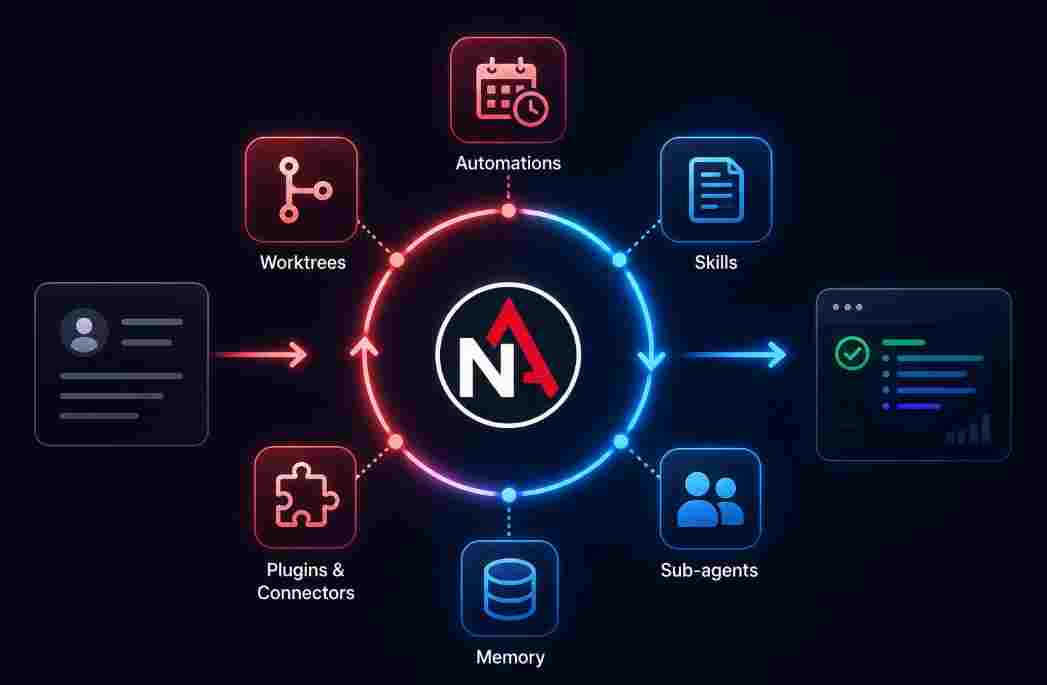
Each loop comprises five key components:
- Automations — The foundation that ensures a loop can be repeated rather than being a one-off event. It enables the AI agent to run on a schedule and do discovery and triage independently.
- Worktrees — Enable two AI agents to work in parallel with each other, avoiding overlap.
- Skills — Instructions for the AI agent to write down project knowledge the agent would otherwise guess.
- Plugins and connectors — Give the AI agent access to tools you already use.
- Sub-agents — Let users set up AI agents so one has the idea while another checks the work.
Osmani also mentioned memory as a sixth component, advising developers to store information such as what is done and what is next in a markdown file or Linear board. "The model forgets everything between runs so the memory has to be on disk and not in the context."
Real-World Applications
OpenClaw's Steinberger has implemented a Codex loop that instructs the AI tool to maintain repositories, wake up every 5 minutes, and direct work to threads. "That makes it easy to parallelize and steer work as needed," he said.
Experts have also urged developers to split loops so one agent writes the code and another checks the final product. It is not advisable to have the same model that wrote the code review its own work because it could be "way too nice" in its evaluation.
The application extends beyond coding. Claire Vo, host of the 'How I AI' podcast, suggested managers can design loops to automate processes like employee onboarding:
"Every Friday, EA, I would like you to review my calendar, see who cancelled on me, where I could have used my time effectively, if there are any followups, and send me a Slack to get this done. And I want you to do that every Friday."
The Challenges
Loops are known to burn through lots of tokens and rack up costs because they often involve long-running tasks that span many steps without always having a clear end-point.
When asked about modifying loops to be more budget-conscious, Steinberger suggested: "Waking up and doing some API calls is fairly cheap, or opt for once per hour/day for lower token use."
Osmani advised developers to spend tokens only where necessary: "Subagents do burn more tokens since each one does its own model and tool work, so spend them where a second opinion is worth paying for."
Claude Code users could also opt for Scheduled Tasks instead of running the AI coding agent in Loop mode. Scheduled Tasks are better for cost-sensitive workflows because they only run at specific times, consuming far fewer tokens than having the agent run on a loop all day looking for something to do.