The $725 Billion Question: Can Nvidia Survive Its Own Customers?
At Computex in Taiwan last week, Nvidia unveiled the RTX Spark superchip — a combination CPU, graphics engine, and up to 128GB of unified memory designed to run large AI models entirely on a laptop. No cloud. No latency. Just a personal AI agent living on your desk.
It sounds revolutionary. But here is the catch: PC makers HP and Dell have been making this same promise for three years. Wall Street and consumers have responded with a collective shrug. High prices. Unclear benefits. Modest features like transcription and photo editing.
Nvidia's version, however, is different. It is aimed at developers and content creators — the people who have long favored Apple's high-end MacBook Pros. Six companies (Microsoft, Asus, HP, Lenovo, Dell, and MSI) will build PCs around the chip. Their stocks surged after the June 1 announcement.
"RTX Spark doesn't make traditional PCs obsolete," says Kevin Hein, an analyst at Tirias Research. "It creates a new category between the workstation and the AI server."
The Cost Problem No One Wants to Talk About
Two barriers stand in the way. First: price. These will be premium devices. Second: a memory chip crunch that has already driven up costs.
Bob O'Donnell, president at TECHnalysis Research, puts it bluntly: "The bulk of PC sales for the next several years will still be more traditional Windows-based PCs with chips from Intel, AMD and Qualcomm."
The timing is brutal. IDC estimates global PC shipments will decline 11.3% in 2026. HP recently warned of a sharp market decline in the second half of the year. The AI PC narrative has not yet translated into sales.
The Real War Is Not in Laptops — It's in Data Centers
While everyone watches the PC battle, a far more consequential war is unfolding in the cloud. Amazon, Google, and Microsoft are spending $725 billion on capital expenditures in 2026 — up 77% from last year. And they are increasingly spending that money on their own chips.
Amazon's custom silicon business (Graviton, Trainium, Nitro) topped a $20 billion annual revenue run rate** in Q1 2026. CEO Andy Jassy says if it were a stand-alone chip seller, the run rate would be **$50 billion — making it one of the top three data center chip businesses in the world.
Google's TPUs are now available outside Google Cloud. Blackstone just launched a $5 billion joint venture to rent them. Anthropic has access to 1 million TPUs. Meta has a leasing deal. Yet Google also just signed a multiyear SpaceX cloud deal involving 110,000 Nvidia GPUs. Google wants both.
Microsoft's Maia 200 accelerator is the furthest behind — only recently live in some data centers for Copilot and OpenAI workloads. The vast majority of Azure's AI work still runs on Nvidia.
Jensen Huang's Parabolic Demand — And Its Limits
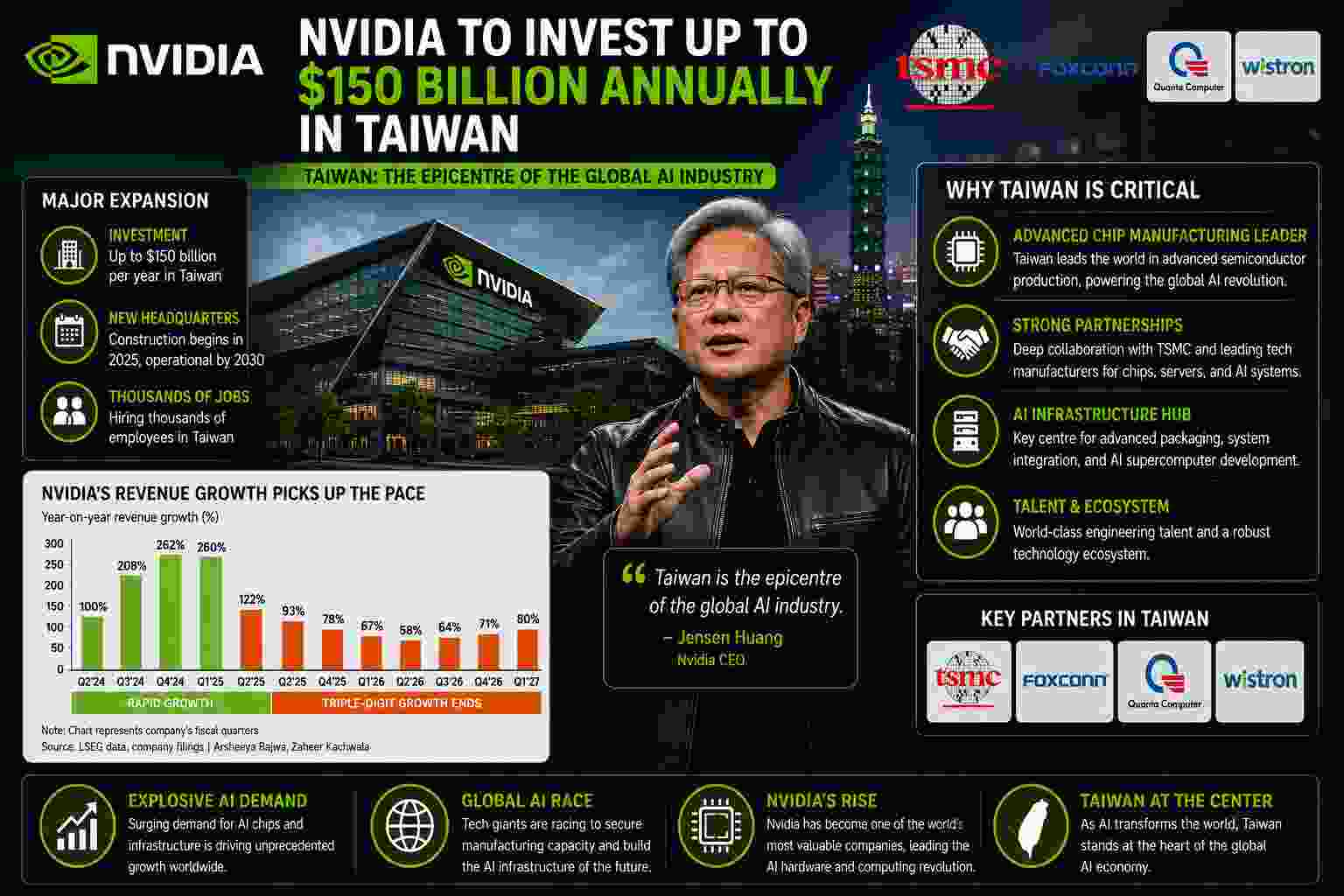
Nvidia's latest results are staggering. Fiscal Q1 2027 revenue rose 85% year over year to $81.6 billion, with data center revenue up 92%. Hyperscalers still make up about half of that business.
"Demand has gone parabolic," CEO Jensen Huang said. He also pointed to a fast-growing tier of buyers — AI startups, enterprises, governments — that "do not build chips, do not design their own chips."
That is the bull case. The bear case is that custom silicon is real and growing, and it will erode Nvidia's pricing power over time. The biggest risk may not be that in-house chips fail — but that they succeed slowly while the market keeps pricing Nvidia for permanent dominance.
What It Means for You
For regular consumers, the AI PC remains a promise, not a product. Nvidia's RTX Spark laptops arrive this fall. Battery life and real-world performance are still unknown. They may finally make Windows machines competitive with Macs on memory bandwidth — a key bottleneck for AI software.
But for investors, the question is different: Can Nvidia keep growing as its biggest customers become its biggest competitors?
At a P/E ratio of about 32, the market is betting yes. But $725 billion in custom silicon spending suggests a more complicated answer.