AI Is Not One Technology – It's a Family of 15+ Subsets Transforming Every Industry
Artificial Intelligence has become one of the most talked-about technologies of our time, yet many people don't realize that AI is not a single, monolithic technology. It is actually a vast family of specialized subsets, each with its own unique capabilities, methodologies, and real-world applications. From Machine Learning to Generative AI, these interconnected technologies work together to build a smarter, more connected world. Let's explore the major subsets of AI and understand how they are transforming industries and everyday life.
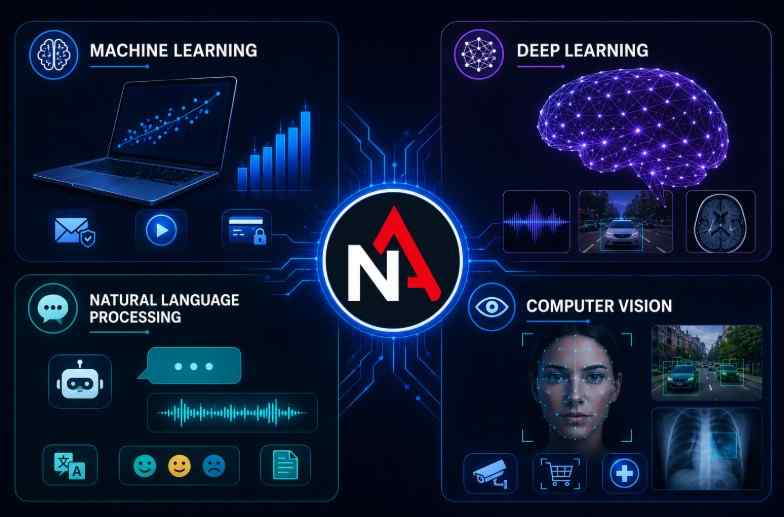
Machine Learning, often considered the foundation of modern AI, enables computers to learn from data and improve their performance without explicit programming. This technology powers many of the digital tools we use daily. When you check your email and find spam automatically filtered out, or when streaming platforms recommend movies based on your viewing history, Machine Learning is at work behind the scenes. Financial institutions rely on it for fraud detection, businesses use it for predictive analytics to forecast trends, and social media platforms employ it for image classification and content moderation. The ability of ML systems to identify patterns in vast datasets has made it indispensable across virtually every sector.
Deep Learning takes this concept further by using neural networks with multiple layers to process information in increasingly complex ways. This subset of Machine Learning has revolutionized fields that require understanding of unstructured data. Speech recognition systems that power virtual assistants, autonomous vehicles that navigate city streets, and medical imaging tools that help doctors detect diseases at early stages all depend on Deep Learning. Natural Language Processing applications and video analysis systems also leverage this technology to interpret and respond to human inputs with remarkable accuracy.
Natural Language Processing enables machines to understand, interpret, and generate human language, bridging the communication gap between humans and computers. When you interact with chatbots for customer support, use translation services to communicate across languages, or dictate messages to your smartphone, NLP is processing and responding to your words. Sentiment analysis tools help businesses understand customer feedback at scale, text summarization systems distill lengthy documents into concise insights, and voice recognition technologies enable hands-free device control. These applications have made NLP one of the most visible and impactful AI subsets in everyday life.
Computer Vision gives machines the ability to interpret and make decisions based on visual data, allowing them to see and understand the physical world. Face recognition technology secures smartphones and streamlines identity verification processes. Object detection powers autonomous vehicles and retail inventory management systems. In healthcare, medical imaging analysis helps radiologists identify abnormalities in X-rays and MRIs with greater accuracy. Surveillance systems and security applications also benefit from Computer Vision, making our environments safer and more efficient.