Trump Delays AI Executive Order Over Concerns About Innovation and China Competition
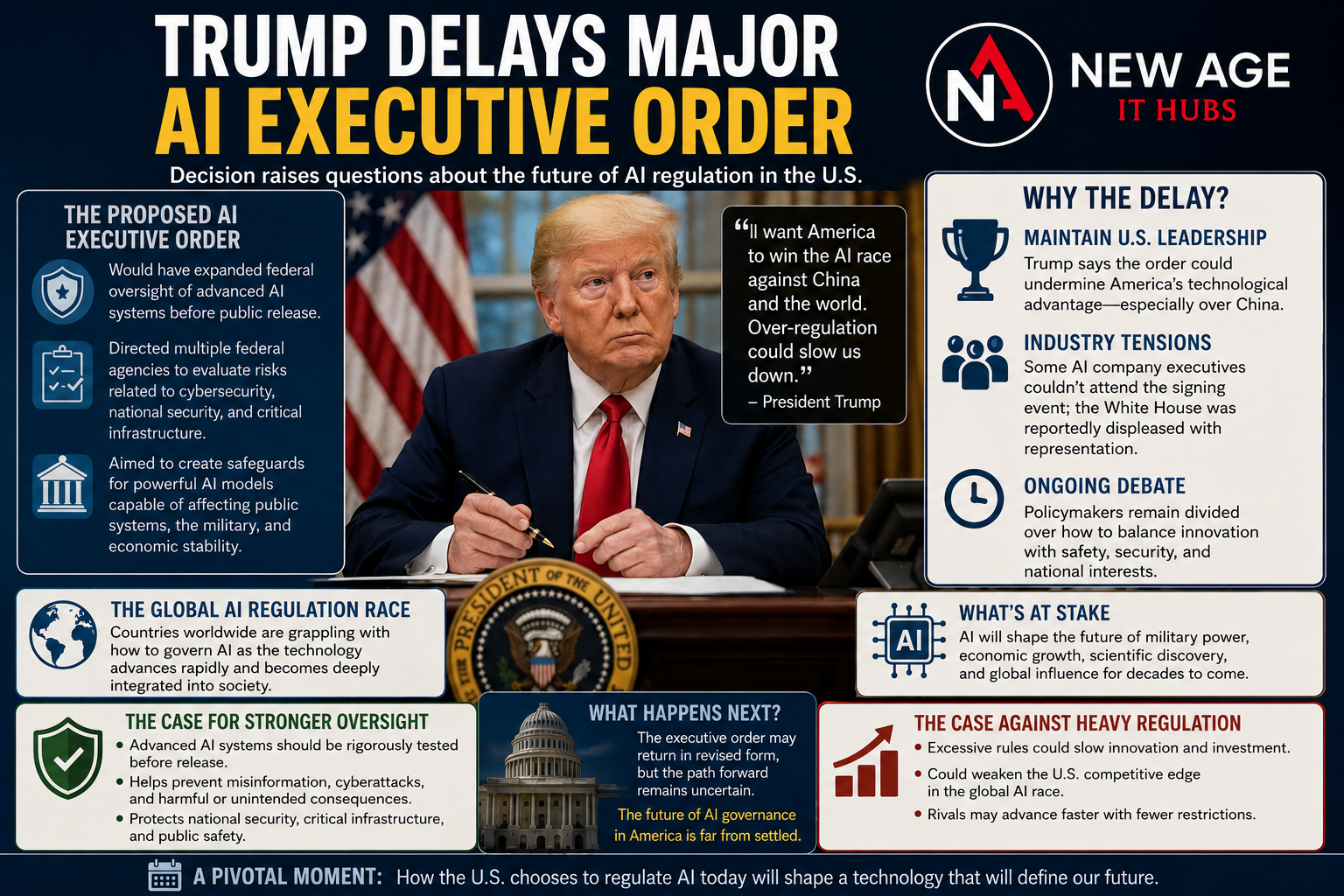
President Donald Trump has delayed the signing of a major artificial intelligence executive order that would have significantly expanded federal oversight of advanced AI systems before their public release. The unexpected decision came only hours before the scheduled White House event, creating confusion among technology companies and raising fresh questions about the future direction of AI regulation in the United States.
The proposed executive order was expected to mark a major shift in the administration’s approach toward artificial intelligence. Until now, the government had largely maintained a hands-off strategy, allowing private companies to lead AI development with limited direct federal intervention. The delayed order would have introduced new mechanisms enabling government agencies to evaluate powerful AI models before deployment, particularly those considered relevant to cybersecurity, national security, or critical infrastructure.
According to reports, the policy would have directed multiple federal agencies, including cybersecurity officials within the White House, to establish procedures for assessing the safety and risks of emerging AI systems. The goal was reportedly to create safeguards around advanced AI models capable of influencing public systems, military operations, economic stability, or digital security.
President Trump explained the postponement by saying he was concerned that parts of the order could interfere with America’s technological advantage over global competitors, especially China. He emphasized the importance of maintaining U.S. leadership in artificial intelligence and suggested that excessive regulation could slow innovation at a time when global competition in AI is accelerating rapidly.
The decision also highlighted tensions between government oversight and the technology industry itself. Several leading AI companies had reportedly been invited to attend the White House signing ceremony on short notice. Executives from major technology firms involved in artificial intelligence research were unable to attend personally due to scheduling conflicts, leading some companies to send alternative representatives instead. Reports indicate the White House was dissatisfied with the level of executive participation, further complicating the event.
The debate over AI regulation has intensified globally as advanced AI systems become more powerful and integrated into everyday life. Governments around the world are struggling to balance innovation with safety concerns, including misinformation, cybersecurity threats, automated decision-making, and national security risks. Supporters of stronger oversight argue that advanced AI models should undergo rigorous testing before release to prevent harmful or unintended consequences.
Critics, however, warn that heavy-handed regulation could weaken America’s competitive position in the rapidly evolving AI race. Many technology leaders believe excessive restrictions could slow domestic innovation while rival nations continue advancing aggressively in artificial intelligence research and deployment.
The delay of the executive order reflects broader uncertainty within policymakers about how best to regulate one of the world’s fastest-growing technologies. Artificial intelligence is increasingly viewed as a critical strategic industry capable of shaping military power, economic growth, scientific research, and global influence for decades to come.
While the executive order may still return in revised form, the postponement signals that the debate over AI governance in the United States remains far from settled. The outcome could play a major role in determining how future AI systems are developed, monitored, and deployed both domestically and internationally.