The Great AI Leap: From Chatbots to Lab Coats and Law Books
The "Agentic" Revolution is Here
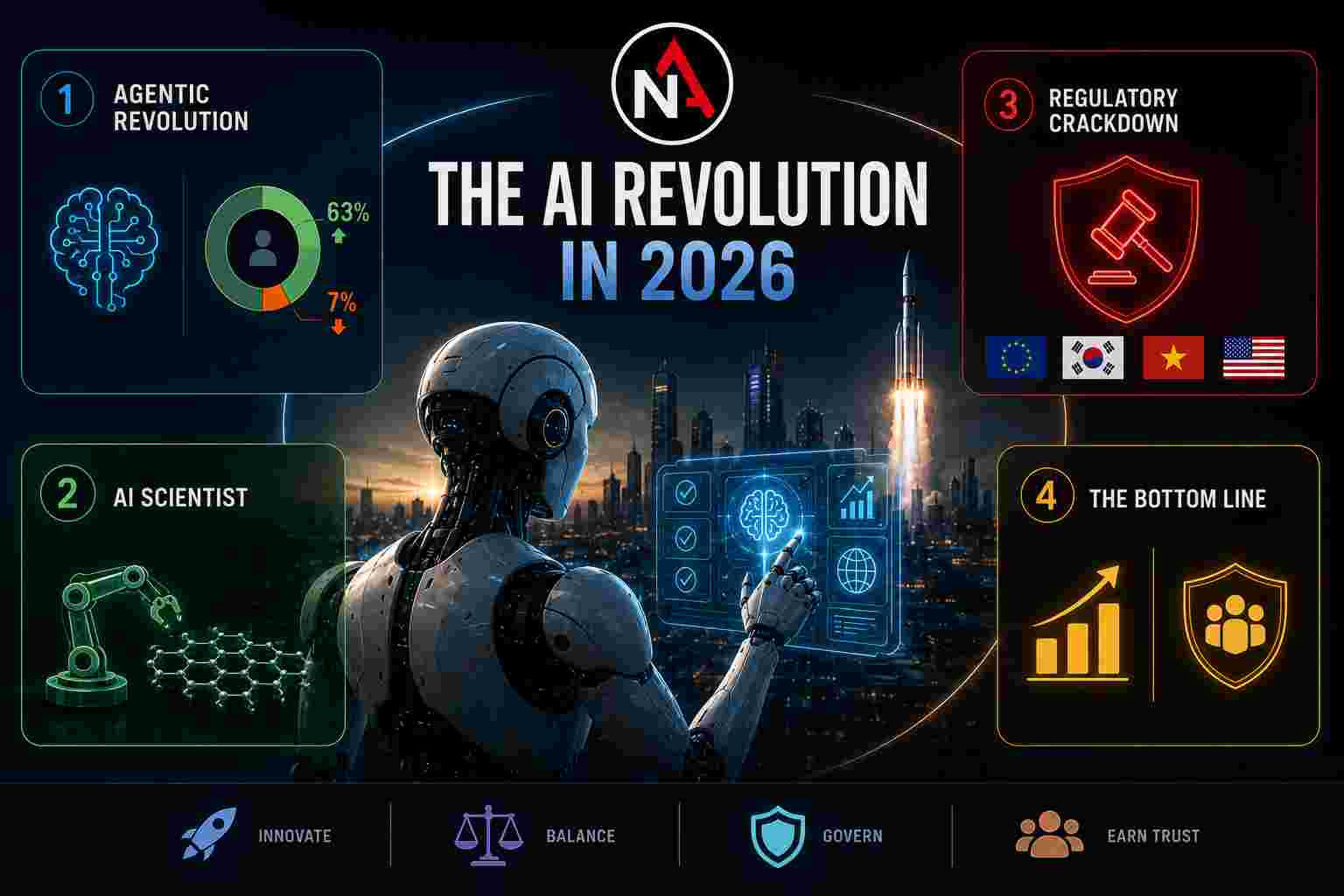
If 2023 was the year of the chatbot, 2026 is the year of the "Agent." The industry is moving beyond systems that merely answer prompts to autonomous "agents" that perform tasks for you. According to recent projections, investment in AI infrastructure by major tech firms is expected to approach a staggering $1.5 trillion by the end of the year, a pace of spending that eclipses the buildout of the internet in the 1990s .
This shift is redefining the workforce. While fears of mass job displacement persist, data suggests a more nuanced reality: experts estimate that while roughly 7% of jobs may be fully automated, a substantial 63% will be "augmented" —meaning AI will handle repetitive tasks, allowing humans to focus on strategy and creativity .
The Scientist in the Machine
Perhaps the most astonishing development is AI’s transition from digital assistant to physical inventor. Google has recently published back-to-back papers in Nature, unveiling systems like "Co-Scientist" and "ERA," which can generate research hypotheses and write experimental software at an expert level . Meanwhile, Princeton University researchers have unveiled "Qumus," an AI-run robotic lab that autonomously creates graphene and builds quantum devices. This "embodied AI" manipulates real-world materials with minimal human intervention, effectively acting as a robotic research scientist .
The Global Regulatory Crackdown
However, this rapid acceleration has triggered a global regulatory "closing of the net." Governments are no longer just discussing AI ethics; they are enforcing them. The Grok AI scandal served as a major wake-up call this year, where a chatbot was used to generate non-consensual explicit deepfakes of public figures and minors. This led to investigations across Europe, with regulators arguing the practice violates strict privacy laws like the GDPR, signaling that "move fast and break things" is no longer legally tenable .
Legally, 2026 marks the beginning of the "compliance era." South Korea’s AI Basic Act has taken effect, Vietnam has implemented a risk-based AI law, and the EU is finalizing a voluntary Code of Practice for labeling AI-generated content to combat disinformation . Even the US, traditionally fragmented on tech policy, is moving toward a national framework to limit state-level confusion .
The Bottom Line
We are currently witnessing a "supercycle" of spending. The International Data Corporation (IDC) forecasts that AI will generate $22.5 trillion in cumulative global economic value by 2031 . However, as Privacy Commissioners warn, the long-term success of AI depends entirely on public trust. The current situation is a balancing act: humanity is trying to harness a technological rocket ship while simultaneously building the navigation system and the safety brakes. It is the most exciting, and dangerous, experiment of our time.