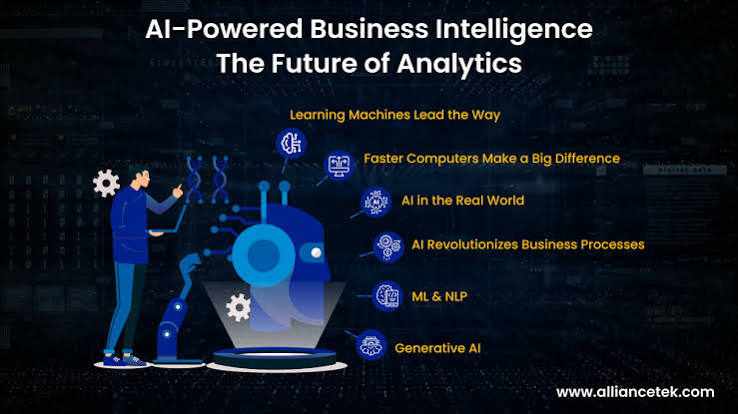
AI-powered analytics is revolutionizing business intelligence by enabling real-time insights, predictive forecasting, and autonomous data exploration. Learn how agentic AI, semantic layers, and natural language interfaces are helping enterprises like P&G and Walmart make faster, smarter decisions.
In today's data-rich but insight-poor business environment, traditional business intelligence is reaching its limits. Static dashboards, rigid reporting cycles, and manual analysis cannot keep pace with the velocity of decision-making required in a digital-first economy . Enter AI-powered analytics — a transformative approach that is reshaping how enterprises derive value from their data.
The Shift from Traditional BI to AI-Driven Analytics
Traditional business intelligence tools like Excel, Tableau, and Power BI rely on data scientists to manually process information and generate static reports. These legacy systems are poorly suited to handle massive datasets, and they prevent companies from accessing valuable real-time insights .
The fundamental difference lies in who — or what — drives the analytical process. In a traditional BI setting, humans initiate every interaction. An analyst writes SQL, knows what they are asking, and can check the answer for accuracy before anyone acts on it. AI-driven analytics flips this model: systems can now initiate analysis without a direct query, run multi-step workflows, and share recommendations without being asked .
This shift is quantified by recent research. A 2025 study of 500 companies found that agentic AI systems reduced task completion times by 34%, increased accuracy by 8%, and improved resource utilization by 14% .
Key Capabilities of AI-Powered Analytics
Agentic AI: The Next Frontier of Business Intelligence
Agentic AI represents a paradigm shift in how business intelligence functions. Rather than asking data teams to chase answers, agentic AI anticipates business needs, explores data autonomously, and delivers insights without being explicitly requested .
The technology combines machine learning algorithms, natural language processing, and real-time analytics into automated data tools. When a sensor or system produces data, agentic AI collects this information, passes it through data pipelines, applies its algorithms, and generates results — all without human intervention .
A 2025 study found that 78% of organizations had concerns about data privacy and agentic AI systems, highlighting the need for robust governance frameworks .
Conversational Analytics: Talking to Your Data
Natural language query capabilities are perhaps the most visible manifestation of AI in business intelligence. Tools like Snowflake's Cortex Analyst and Databricks' Genie allow business users to ask questions about their data in plain English and receive relevant visualizations and insights .
As one CIO put it: "Why should you need a dashboard when you can talk to your data?"
However, this capability depends heavily on a governed semantic layer. Without a consistent understanding of business terms, natural language querying quickly breaks down. As AtScale's CTO Dave Mariani noted: "When an LLM queries a replicated extract or a raw warehouse schema without a governed context, it doesn't know what 'gross margin' means for your organization" .
Predictive and Prescriptive Analytics
AI-powered analytics doesn't just show what happened — it predicts what will happen and recommends actions. Machine learning models trained on historical data can forecast future outcomes, spot emerging trends in consumer behavior, and help businesses align their product and service offerings with growing demand .
This capability is especially valuable in retail. Walmart applies an agentic AI dashboard to forecast demand for 500 million items weekly — as the system learns with more data, improved forecasting results in significant cost savings .
Real-World Applications Across Industries
Consumer Goods: Procter & Gamble
P&G, a pioneer in analytical research since 1924, has developed an "AI factory" that provides a platform for rapidly developing, testing, deploying, and monitoring AI algorithms. The factory reduces time to model deployment by roughly six months .
The company's Pampers My Perfect Fit application uses an AI-driven questionnaire to provide diaper fit recommendations that are 90% accurate for preventing leaks. Another system in Brazil splits and schedules customer orders into truck-size loads, reducing out-of-stock occurrences by 15% .
Healthcare: Mayo Clinic
The Mayo Clinic uses an agentic AI platform to analyze large volumes of patient records and flag patients who may be at high risk for specific conditions. Telemedicine companies leverage real-time data from wearable devices to automatically identify health risks and alert providers .
Retail: Walmart
Walmart's agentic AI dashboard forecasts demand for half a billion items weekly. As the system continuously learns from more data, forecasting accuracy improves, driving significant cost savings across the supply chain .
Customer Service: Delta Air Lines
Delta applies sentiment analysis through agentic AI dashboards to proactively monitor customer feedback and address concerns. The company reports that this strategy has led to a 30% increase in customer satisfaction ratings .
Cybersecurity
Agentic AI dashboards have revolutionized system monitoring and threat detection. Engineers receive predictions about when systems are likely to fail, allowing preventive maintenance. In cybersecurity, AI enables companies to process trillions of threats weekly and generate actionable insights. Some organizations use unsupervised learning to detect and respond to threats autonomously .
The Critical Role of Semantic Layers
One of the most important lessons from the AI analytics revolution is that powerful AI is useless without a solid data foundation. That foundation is the semantic layer — a centralized repository of business logic, metric definitions, hierarchies, and business rules .
In the BI era, semantic inconsistencies were frustrating but manageable. Analysts could flag differences in how "revenue" was defined across departments. That buffer is now gone. Autonomous systems that use different definitions amplify errors at machine speed — one bad definition can produce thousands of incorrect outputs downstream .
The data supports this concern. AtScale used the industry-standard TPC-DS benchmark to compare LLM performance directly. LLMs querying raw database tables achieved roughly 20% accuracy on complex, multi-fact business queries. With a governed semantic layer, accuracy reached 100% .
Major platforms have recognized this critical need. Snowflake has introduced native Semantic Views, allowing organizations to "define metrics once, trust them everywhere." The company's Semantic View Autopilot uses AI to instantly generate comprehensive semantic models based on actual data patterns . Databricks AI/BI is built directly on the Unity Catalog governance framework, ensuring consistent security and lineage across all analytics .
Future Trends in AI-Powered Analytics
The Rise of Model Context Protocol (MCP)
MCP is an emerging standard for connecting LLMs and autonomous agents directly to governed, semantic-rich metadata. This enables enterprises to securely expose their semantic models to AI agents across tools like Claude, ChatGPT Enterprise, and custom-built copilots .
Real-Time and Embedded Analytics
When data is embedded into operational systems like CRMs or customer service platforms, it must be both fast and trustworthy. Semantic layers enable live querying across cloud warehouses without requiring data movement, enabling confident decisions made at the point of customer interaction .
Ethical Considerations
As Gartner estimates that AI will impact 70% of all software applications by 2026, organizations must address ethical concerns. Biased training data can result in discrimination; inadequate data privacy protections can lead to compliance violations. Companies must take steps to ensure algorithms are trustworthy and managed properly .