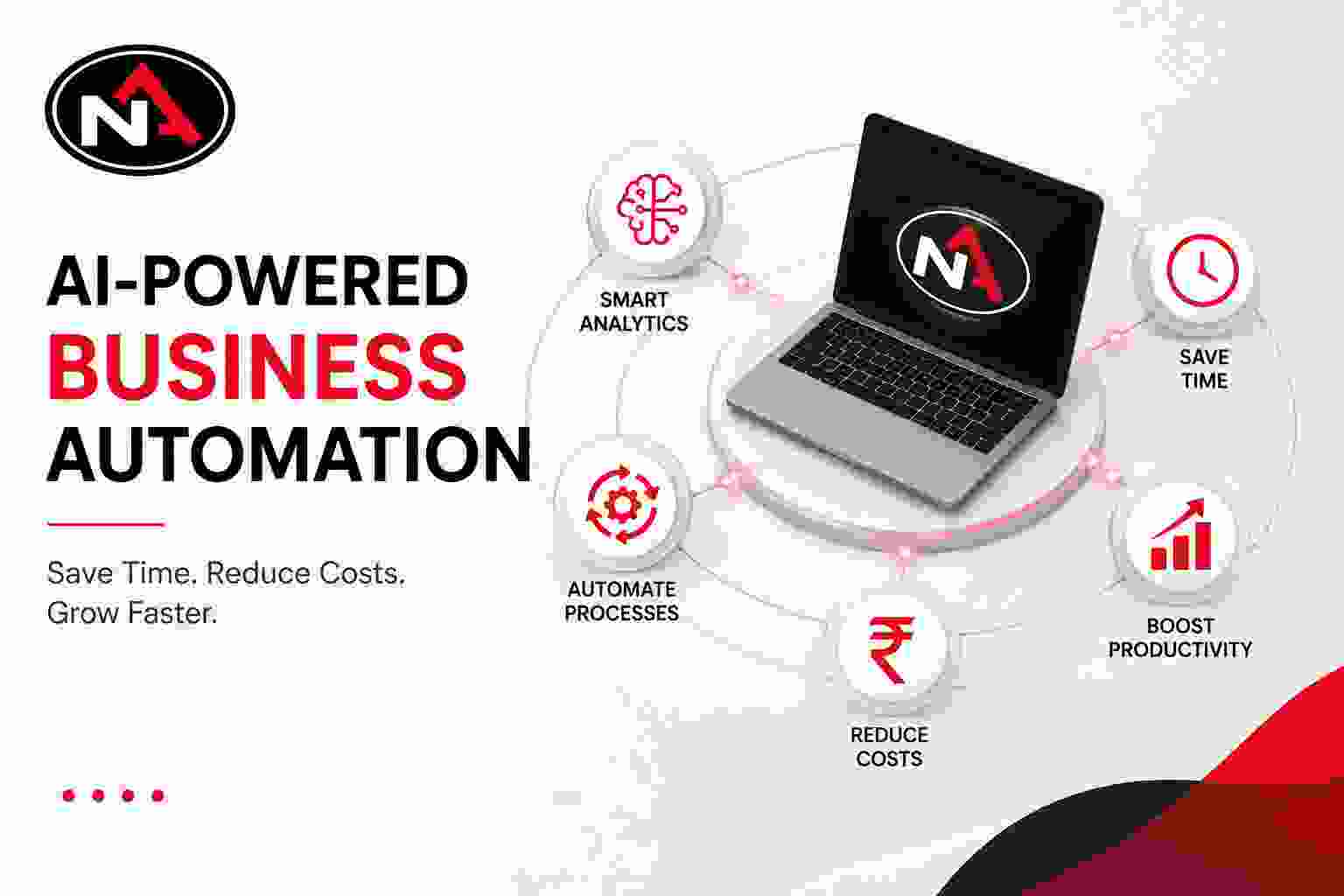
Discover how AI-powered business automation can reduce repetitive work, improve productivity, lower operational costs, and help businesses make faster decisions.
Businesses today are under constant pressure to work faster,
reduce costs, improve customer service, and make better decisions. At the same
time, employees often spend a significant amount of their working hours on
repetitive tasks such as data entry, reporting, customer follow-ups, document
processing, scheduling, and routine communication.
AI-powered business automation is changing the way companies
handle these activities. By combining artificial intelligence with automation,
businesses can create smarter workflows that can understand information, make
decisions based on predefined rules, and complete repetitive tasks with minimal
human intervention.
For small businesses as well as large enterprises, this
approach can improve efficiency while allowing employees to focus on more
valuable and creative work.
What Is AI-Powered Business Automation?
AI-powered business automation uses artificial intelligence,
machine learning, APIs, and software workflows to automate business processes.
Traditional automation generally follows fixed rules. For
example, a system may automatically send an email whenever a customer submits a
form.
AI-powered automation can go further. It can analyze
customer information, understand incoming requests, categorize data, generate
responses, identify patterns, and recommend the next action.
This makes automation more flexible and useful for complex
business processes.
How AI Automation Can Help Businesses
1. Reduce Repetitive Work
Employees often perform repetitive activities every day.
Data entry, invoice processing, report generation, email sorting, and customer
follow-ups can consume valuable working hours.
AI automation can handle many of these activities
automatically. This reduces manual effort and allows employees to spend more
time on tasks that require human judgment.
2. Improve Operational Efficiency
Automated workflows can connect different departments and
software systems.
For example, when a new customer registers, an automated
workflow could create a customer profile, send a welcome message, notify the
sales team, schedule a follow-up, and update the CRM system.
Instead of employees performing each step manually, the
workflow can coordinate the entire process.
3. Reduce Business Costs
Automation can help companies reduce the amount of time
spent on routine operations. When processes become faster and require fewer
manual steps, businesses can improve productivity without continuously
increasing operational workload.
The goal is not simply to replace employees. Instead,
businesses can use AI to help employees accomplish more in less time.
4. Faster Customer Support
AI-powered systems can assist customer support teams by
automatically categorizing queries, finding relevant information, generating
initial responses, and forwarding complex issues to the appropriate employee.
This can reduce response times while allowing support teams
to concentrate on issues that genuinely require human assistance.
5. Better Business Decisions
Modern businesses generate large amounts of data from
customers, sales, operations, websites, and internal systems.
AI can analyze this information and identify patterns that
may be difficult to detect manually. Businesses can use these insights to
understand customer behavior, monitor performance, identify potential problems,
and improve planning.
Examples of Business Automation
AI-powered automation can be implemented across many areas
of an organization.
Sales: Lead qualification, follow-up reminders,
customer scoring, and sales reporting.
Marketing: Content workflows, customer segmentation,
campaign analysis, and personalized communication.
Finance: Invoice processing, expense tracking,
payment reminders, and financial reporting.
Human Resources: Employee onboarding, document
collection, attendance workflows, and internal communication.
Customer Support: Ticket classification, automated
responses, knowledge-base assistance, and escalation.
Operations: Inventory monitoring, alerts, approvals,
scheduling, and workflow management.
AI Automation and Custom Software
Every business operates differently. Off-the-shelf
automation tools may solve common problems, but they may not always fit a
company's specific processes.
Custom software development allows businesses to build
automation around their existing workflows and requirements.
A custom solution can connect CRM, ERP, accounting,
websites, databases, APIs, and other internal systems into a single automated
workflow.
This approach can be particularly useful for businesses with
complex processes or specialized requirements.
What Should Businesses Automate First?
Businesses should not try to automate everything at once. A
better approach is to identify processes that are repetitive, time-consuming,
rule-based, and frequently performed.
Start by analyzing the current workflow and identifying
where employees spend the most time.
After selecting a suitable process, businesses can implement
automation, measure the results, and gradually expand automation to other
departments.
The Future of Business Automation
AI is making business automation increasingly intelligent.
Future systems will not only execute predefined tasks but will also be able to
analyze situations, recommend actions, interact with different software
systems, and support employees throughout complex workflows.
AI agents and intelligent automation could become an
important part of everyday business operations, helping organizations respond
faster while maintaining better control over their processes.